



Last Updated:
Without urgent governance reforms and fair, inclusive polls, Bangladesh risks democratic collapse and the permanent erosion of its pluralism, social cohesion, and national values


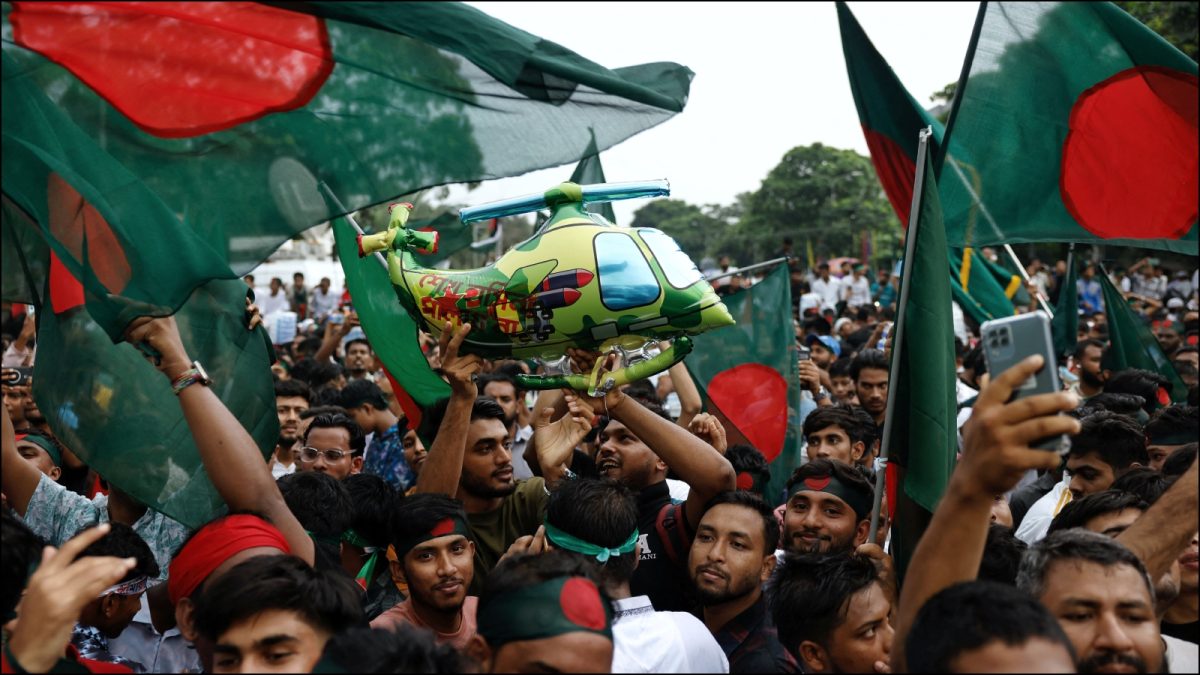
Sovereignty, security, and national identity cannot be preserved through scapegoating, conspiracy narratives, or the deliberate exploitation of anger and fear. (File pic/Reuters)
Bangladesh teeters on the brink of chaos, where governance failure, radicalisation, and political violence are eroding the very foundations of democracy, secularism, and social cohesion.
The situation in Bangladesh deteriorated sharply after the killing of Sharif Osman Hadi on 18 December 2025, triggering widespread violence, mob attacks, and escalating political instability. In the aftermath, protesters targeted The Daily Star, Prothom Alo, and other media outlets, accusing them of political bias and, in some instances, alleged ties to foreign influence. These assaults on the press—core pillars of democracy—were contained only because security forces, including police and fire services, intervened; without their action, journalists and staff could have been burned alive. Mobs also vandalised public and cultural institutions, while protests near Indian diplomatic premises forced heightened security and the suspension of consular operations.
More disturbingly, the violence extended beyond institutions and political rivals. A Hindu man, Dipu Chandra Das, was lynched, tied to a tree, and burned alive in Mymensingh, with bystanders filming rather than helping. At the same time, a seven-year-old—the daughter of BNP leader Ayesha Akter—was killed when mobs set her family home in Lakshmipur on fire, leaving others critically injured. These incidents reveal a profound moral collapse, where mob violence overrides humanity and political differences justify extreme brutality against civilians, minorities, and even children.
India as a Convenient Scapegoat
Despite no credible evidence, India was hastily blamed for Hadi’s killing, even though Bangladesh’s law enforcement emphasised that the investigation is ongoing. As Additional Inspector General of Police Khandaker Rafiqul Islam noted, “We do not have specific information about the prime suspect’s last location… however, we have not received any reliable information indicating that he has left the country.” Police also confirmed there is no verified evidence that the attackers fled into India.
Significantly, even within Bangladesh, this narrative is now being openly challenged. Sharif Osman Hadi’s brother, Sharif Omar bin Hadi, has accused Chief Adviser Muhammad Yunus’ interim government of responsibility for the killing, claiming it aimed to disrupt the upcoming elections. Speaking at a Shahbagh rally, he said, “It is you who had Osman Hadi killed, and now you are trying to foil the election by using this as an issue.”
Addressing a public gathering, he stated that his brother was committed to ensuring elections by February 2026 and that his murder was intended to sabotage that process. He further asserted that the interim administration cannot evade responsibility for a crime committed under its watch and demanded swift justice. While these allegations are still under investigation, they directly contradict the rush to externalise blame and reinforce the argument that the roots of the crisis lie primarily in Bangladesh’s internal political and governance failures rather than any foreign conspiracy.
From a strategic perspective, India has no interest in destabilising Bangladesh. An unstable Bangladesh directly threatens India’s security, economy, and border management. With a shared border of over 4,000 kilometres, instability can fuel cross-border crime, militant infiltration, refugee flows, disrupt trade and connectivity projects, and create opportunities for foreign powers like China and Pakistan to expand influence, undermining India’s strategic interests. It can also heighten communal tensions and humanitarian challenges spilling into India. The key question is not who is blamed, but who truly benefits from this chaos.
Political Violence Beyond Party Lines
The narrative that the violence is directed only against the Awami League is demonstrably false. The killing of a BNP leader’s child makes it clear that any political force perceived as a potential challenger is now a target. This is a deliberate attempt to clear the political field ahead of future elections, using fear and violence as tools of control.
The role of Chief Adviser Muhammad Yunus in this crisis raises serious concerns. Appointed on 8 August 2024 to lead Bangladesh’s caretaker government, his mandate was to ensure neutrality, restore law and order, uphold constitutional governance, and prepare for free, fair, inclusive, and credible elections. Instead, he has consolidated power while the interim administration has presided over prolonged instability, weakened institutions, and a deteriorating security environment.
Rather than addressing governance failures, it has repeatedly externalised blame—particularly towards India—allowing conspiracy narratives to replace accountability. Even after more than sixteen months in office, with elections announced for February 2026, the focus remains on sustaining fear, uncertainty, and polarisation, using external scapegoating to deflect responsibility and consolidate control.
Governance Failure and Radicalisation
Bangladesh was once celebrated globally for its remarkable progress in human development, social indicators, and its world-renowned garment industry. The country reduced extreme poverty from 44.2 per cent in 1991 to just 11.3 per cent in 2022, achieved near-universal primary education with 97 per cent enrolment and gender parity, and became the world’s second-largest exporter of ready-made garments, accounting for roughly 80 per cent of its exports and employing over four million workers, mostly women. It also gained international recognition for improvements in workplace safety. In the South Asian context, Bangladesh was often cited as a model for human development, showing that sustained investment in education, health, and women’s empowerment could drive significant social and economic progress.
Today, however, those achievements are rapidly fading. Under the current leadership, the country is drifting towards an environment resembling fragile and conflict-ridden states, marked by constant protests, political violence, and institutional breakdown.
Rather than focusing on economic revival, social cohesion, and democratic consolidation, the administration seems preoccupied with alienating India and reinforcing a siege mentality, perceiving itself as constantly threatened and prompting defensive, insular, and provocative behaviour. Radical elements—emboldened during last year’s protests—have exploited this vacuum. Police stations were attacked, weapons looted, and these arms now circulate freely, strengthening extremist networks.
Alarmingly, sections of the student leadership and affiliated groups continue to issue openly hostile statements against India, including provocative remarks about India’s Northeast and declarations that Bangladesh would “provide shelter to forces inimical to India” and assist actors seeking to destabilise the country. This rhetoric escalates political dissent into explicit endorsement of cross-border destabilisation.
Bangladesh’s proximity to India’s Siliguri Corridor further magnifies the regional implications, making rising radicalisation and anti-India narratives a serious regional security threat.
Hardline Islamist organisations, including Hefazat-e-Islam Bangladesh, Hizb ut-Tahrir Bangladesh, Jamaat-ul-Mujahideen Bangladesh (JMB), Harkat-ul-Jihad-al-Islami Bangladesh (HuJI-B), Ansarullah Bangla Team (ABT), Jamaat-e-Islami and its student wing Islami Chhatra Shibir, have capitalised on this instability to expand their influence. They are staging large rallies, mobilising supporters, and infiltrating student and community networks, effectively embedding radical ideologies within society.
Notably, they are manipulating students—who may not fully understand these groups’ broader objectives—to serve their agendas, using youthful energy and idealism to advance radical causes. These groups are increasingly dictating public discourse, framing protests around religious and nationalist rhetoric, and normalising extremist behaviour. The combination of weakened governance, political unrest, and the spread of radical narratives is creating fertile ground for long-term societal radicalisation, threatening not only Bangladesh’s internal stability but also regional security dynamics.
Erosion of Secular and Bengali Identity
Perhaps the most tragic dimension of Bangladesh’s current trajectory is the erosion of its secular, inclusive Bengali identity. The country was founded on principles of pluralism, linguistic unity, and tolerance, with Bengali identity at its core—the very identity around which the people fought and sacrificed to create the nation in 1971.
Today, those foundations are being systematically dismantled. Cultural symbols are being destroyed, history rewritten, and even the role of India in Bangladesh’s 1971 liberation has been deliberately erased from public memory.
Statues and memorials associated with the Liberation War have been vandalised, longstanding cultural institutions that embody pluralism have come under attack, and historic sites—including the Tagore ancestral home and the Mujibnagar Memorial Complex—have been desecrated. Shrines and minority religious sites have also faced attacks, further eroding the cultural fabric of the nation.
The silencing of commemorations, the targeting of minorities, and the rise of ideological intolerance signal a profound identity shift—from inclusive nationalism to radicalised exclusivism. The mob violence witnessed today is not spontaneous; it is the manifestation of a deeper ideological capture of society. This transformation is closely linked to the growing erosion of democratic norms and civic values.
Bangladesh is increasingly resembling a mobocracy, where the rule of law has been replaced by street justice and political intimidation. The constant cycle of protests, attacks on parliament, destruction of public property, and suppression of dissent reflects a society trapped in perpetual unrest. Ironically, the very newspapers and institutions that supported last year’s protests are now under attack. Many of the students who once championed constitutionalism, liberal democracy, the rule of law, and civil rights are now either complicit in or silent about these violent turnarounds—raising the question of what became of the ideals they once espoused.
Strategic Consequences and Regional Implications
Bangladesh’s instability will not harm India as much as it will destroy Bangladesh from within. Radical ideologies, once entrenched, become self-sustaining and expand beyond borders. The growing space for extremist networks will eventually pose challenges not only to India but also to the United States, which underestimated the consequences of a poorly managed political transition. The American deep state shares part of the responsibility for facilitating this process, as it should have anticipated the outcomes of such political engineering.
Today, hostile forces have captured significant influence in Bangladesh, with China and Pakistan increasing their presence and engagement. China’s support for radical elements threatens not only Bangladesh’s internal stability but also undermines US long-term strategic interests in the region, as the rise of radicalised proxies and foreign influence weakens democratic governance, regional stability, and American influence in South Asia.
Notably, even external stakeholders have cautioned Bangladesh against this reckless turn. Russia’s Ambassador to Bangladesh, Alexander Grigoryevich Khozin, publicly urged Dhaka to ease tensions with India, stating, “The sooner you reduce tensions with India, the better. Because, historically, since 1971, when Bangladesh gained independence, it was mostly because of Indian help. And Russia also supported this.” He stressed that regional stability depends on responsible diplomacy rather than manufactured hostility. That such a reminder had to come from a foreign envoy underscores how far sections of Bangladesh’s political discourse have drifted from historical reality, allowing short-term political expediency and radical narratives to eclipse facts, gratitude, and strategic logic.
Ultimately, the responsibility lies squarely with Bangladesh’s leadership. Sovereignty, security, and national identity cannot be preserved through scapegoating, conspiracy narratives, or the deliberate exploitation of anger and fear. Without urgent reforms in governance, accountability, and the restoration of free, fair, inclusive, and participatory elections, Bangladesh risks not only the collapse of its democratic institutions but also the permanent erosion of the pluralism, social cohesion, and values that once defined the nation. History will judge this period harshly, and the window to reverse this dangerous trajectory is rapidly closing.
The writer is a visiting research fellow at the International Centre for Peace Studies, New Delhi. Views expressed in the above piece are personal and solely those of the author. They do not necessarily reflect News18’s views.
December 25, 2025, 19:54 IST
Read More
