



India is home to over 2400 dumpsites that collectively hold more than 2,33 crore tonnes of waste every year.
Upon learning this staggering statistic, Sandeep Tiwari decided to act on it, and in 2018, he founded Waste is Gold Technologies to ensure that no waste ends up in landfills.
“We wanted to promote decentralised waste management solutions globally and create technologies that empower communities to manage their own waste efficiently, sustainably, and responsibly,” Tiwari, the founding and managing director of Waste is Gold, tells YourStory.
Headquartered in Bengaluru, the climate tech startup operates with a 25-member team across India and has a local manufacturing site, where it designs and develops its products.
Turning waste into value with tech
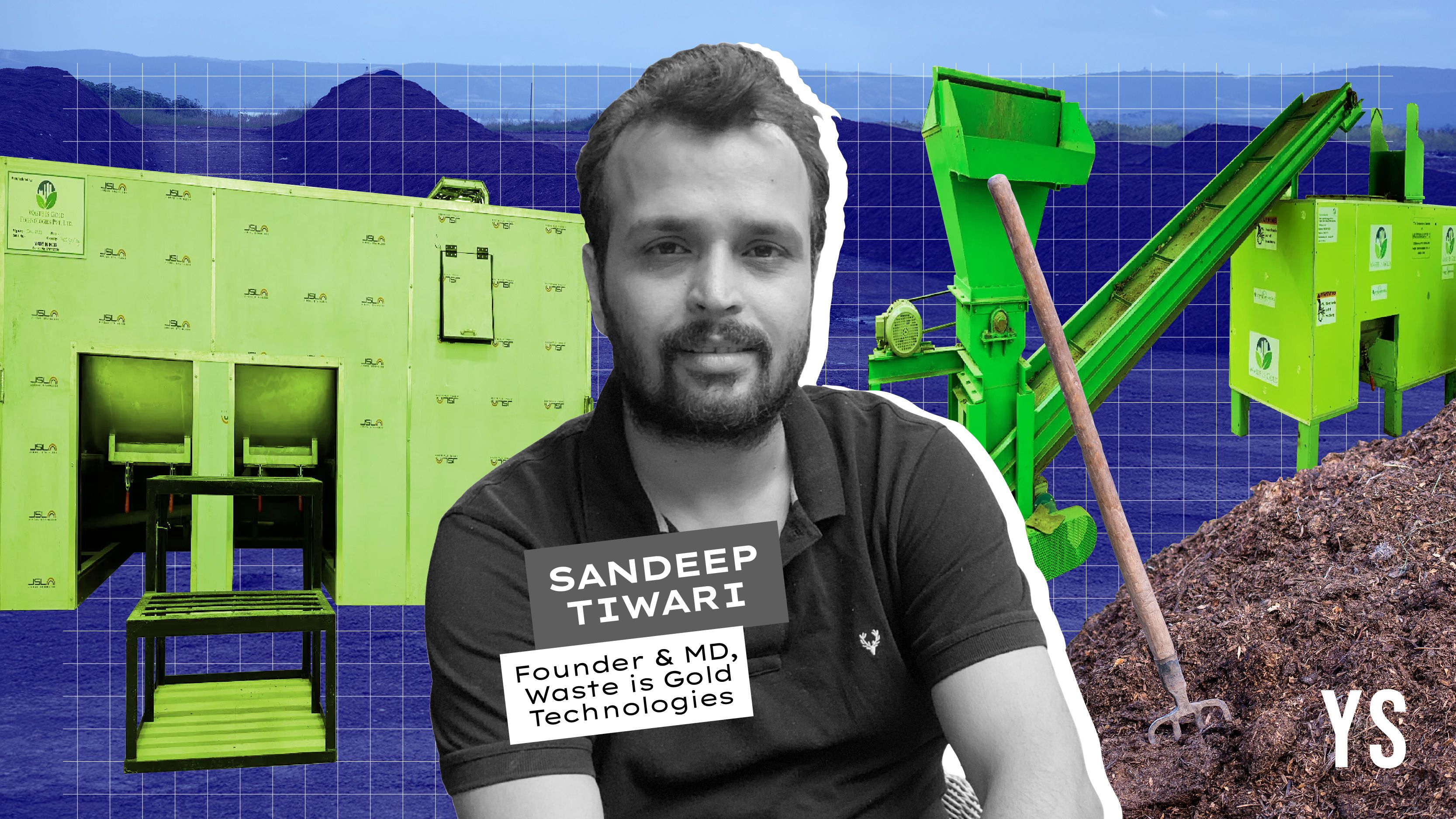
Waste is Gold’s moonshot product is its Organic Waste Converter (OWC)—a high-speed, rapid natural composting machine—suitable for commercial and municipal applications, which, the founder claims, produces zero emissions.
“It is equipped with a system that processes organic waste in just eight hours and has diverted over 383.52 million kg of waste from landfills so far. Unlike conventional methods that consume significant labour and energy, the technology is designed for simplicity, efficiency, and speed,” shares Tiwari, adding that the system produces nutrient-rich compost, ready to use in gardens and landscaping projects.
According to Tiwari, OWC’s reliability has been reinforced by the Central Food Technological Research Institute. The startup is also developing an Automatic Waste Segregation Machine (AWSM), which will “fully automate the segregation of municipal solid waste, reducing human intervention and improving efficiency”.
Additionally, it is developing its advanced biogas with pre-treatment, as part of its advanced multi-reactor biomethanation R&D programme, which aims to convert organic waste into renewable energy in a sustainable way with zero foul smell.
Beyond the large-scale projects, the climate tech startup is also building a portable home composter, designed for households to compost their organic waste on-site.
“It empowers individuals to reduce their environmental footprint, turn waste into nutrient-rich compost, and support a zero-waste lifestyle while even growing their own food using organic waste,” he elaborates.
Scaling a sustainable business
In just seven years since its inception, Waste is Gold has expanded to over 300 locations in India. Within the next five years, it plans to expand internationally across the Asia-Pacific region, Australia and New Zealand, the Middle East, North America, and Europe.
The startup is currently working on over 300 live projects for clients, including Prestige Group, DLF, Lodha, L&T, Shapoorji, Caterpillar, MyHomes, and Aditya Birla. Its project costs range from Rs 3.5 lakh to multiple crores, depending on the project’s size. According to Tiwari, Waste is Gold is presently handling projects worth Rs 100 crore.
The market size of India’s waste management sector is projected to grow to $29.71 billion by 2035. He says the transformation is largely guided by strong policy interventions, most notably, the Solid Waste Management (SWM) Rules of 2016, “which expanded the scope of regulation to all urban local bodies, event organisers, and even industrial townships”.
“The 2016 Rules mandate that waste must be segregated at source into at least biodegradable, dry/non-biodegradable and domestic hazardous streams. For waste with high calorific value (≥ 1,500 kcal/kg), the rules discourage dumping in landfills and instead promote its use for energy generation,” he explains.
Tiwari adds that challenges persist, such as finding suitable land for sanitary landfills. “Many urban bodies struggle with financial sustainability, user fee recovery, and ensuring high-quality segregation from source, which directly affects the economic and operational viability of recycling and treatment plants,” he adds.
Bootstrapped, the startup focused on “revenue-generating initiatives to avoid cash crunches.” Tiwari adds, “Our clients’ belief in our products has also been instrumental in keeping us operational and funded.”

The road ahead
Waste is Gold plans to raise project-based funding between Rs 100 crore and Rs 200 crore to fuel initiatives, like public-private partnerships and community-scale waste management projects.
“The goal is to collaborate with philanthropists and impact investors who share our vision for climate change mitigation and a sustainable future. The funds would be invested in expanding our technology deployment, advancing R&D, and scaling,” he says.
Competing with companies like Pune-based Green Planet Solutions and Haryana-based Kelvin Water Technologies, Tiwari believes Waste is Gold stands apart with no direct peers.
“Our USP lies in high-speed, energy-efficient natural aerobic composting with zero emissions that is both efficient and environmentally friendly. This sets us apart in the Indian and global waste management landscape,” he signs off.
