
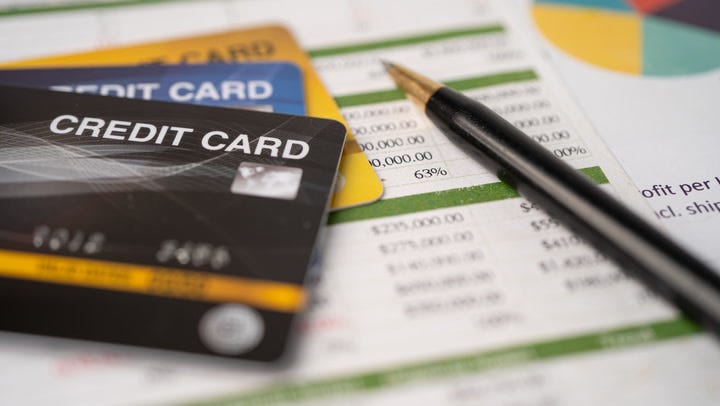

Credit card debt hits record $1.23 trillion as economic divide widens
Americans’ credit card balances surged to an all-time high of $1.23 trillion in the third quarter, rising $24 billion from the previous period.
Cheddar
There are times when discussions about the economy, personal finance, and business expenses feel just as overwhelming as managing your budget.
Experts throw around the terms like bull market and bear market when discussing the stock market for periods of rising stock prices or decreasing stock prices. They argue about why we should or should not be concerned about stagflation, the k-shaped economy and inflation.
It is hard to know what you think is happening, when it feels like everyone already knows all the terms and you don’t. Here’s a set of definitions for common and emerging economic and fiscal terms often seen bandied about in news reports.
What is inflation
Inflation is a period of persistently higher prices for goods and services as measured by the Consumer Price Index (CPI). It is marked by a period of declining purchasing power of currency.
What is a k-shaped economy
A so-called k-shaped economy reflects a physical image of different sectors in the country recovering at different rates from an economic downturn. According to Forbes, in a k-shaped economy high-income groups spend strongly while lower-income consumers curtail spending and are more conscious of looking for bargains.
What is the new normal
Experts have debated whether the concept of higher prices becoming a “new normal” in the wake of post-COVID-19 elevated prices and higher inflation rates should be referred to in such a manner. For the time being, at least, the jury is out.
What is (or was) a partial government shutdown
The most recent and longest government shutdown lasted 43 days. It ended Nov. 10, 2025, when the Senate voted 60-to-40 to pass an agreement to fund all necessary appropriation bills for fiscal year 2026. The U.S. House, by a vote of 222 to 209, voted its approval on Nov. 12 with President Donald Trump signing it into law later that evening. The partial government shutdown of 2018 to 2019 had been the longest to date lasting 35 days. It was described as a partial shutdown because Congress had already enacted five of the 12 regular appropriation bills. Since 1981, there have been five major government shutdowns.
What is a recession
Experts define it as two consecutive quarters of negative gross domestic product growth (GPD) It results in a significant decline in economic activity across the full spectrum of the U.S. economy lasting more than a few months, according to the National Bureau of Economic Research. Job losses, less spending and investment, and a drop in stock prices are byproducts of an economic recession.
The Great Recession of 2008 came as result of the collapse of the U.S. housing bubble sparked by subprime and predatory mortgage lending.
What is stagflation
Here’s what causes stagflation and why the US may be at risk for it
The U.S. may be at risk for stagflation – a combination of slow growth and inflation. Here’s what happened the last time the country experienced it.
Just the FAQs, USA TODAY
Stagflation can occur when economic growth stagnates, inflation rises and unemployment increases. Examples often cited include the oil crises of 1973 and 1979, the latter of which resulted from the Iranian Revolution.
What are tariffs
Tariffs are taxes imposed on imported goods as a means of hopefully creating a fairer trade balance and protecting domestic industries. It also raises government revenue but at the same time leads to higher prices of foreign products. According to the nonprofit think tank Tax Foundation, Trump’s series of tariffs in 2025 placed on trading partners Canada, China, Mexico and the European Union constitute the largest tax increase as a percent of GDP since 1993.
