









Last Updated:
The Bihar verdict is the culmination of a long journey: from the Mandal-era assertion to the aspiration-driven imagination of a new Bihar


Bihar has voted for continuity. But in doing so, it has also reimagined its political future.
‘Power is the ability to shape the future without being trapped by the past.’
— Hannah Arendt
Bihar has once again rewritten its political story. The 2025 Assembly verdict, returning the NDA government with a sweeping majority, is not merely an electoral decision. It is a profound civic gesture, a conscious resetting of historical memory. It marks a moment when the electorate decides not only who will govern but how Bihar wants to imagine itself in the years ahead.
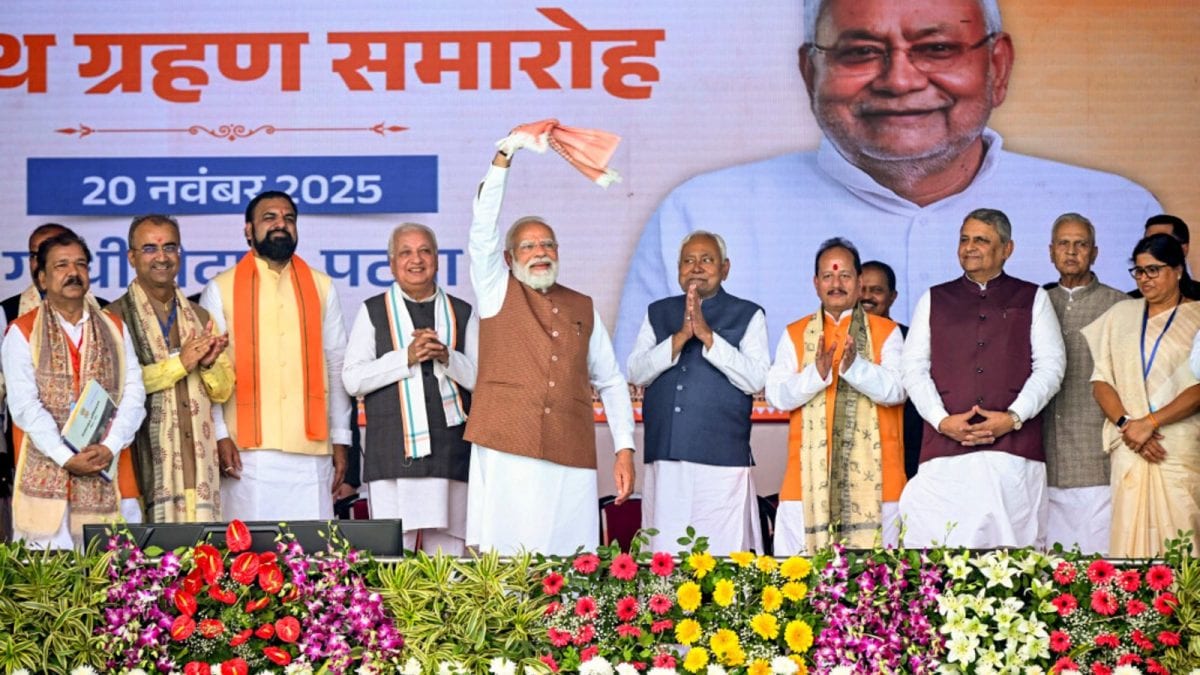
Nitish Kumar, taking oath for the tenth time, stands not as a routine incumbent but as a long-distance runner in a state where politics has often been a relay of ruptures. His rivals in the INDIA bloc, Rahul Gandhi and Tejashwi Yadav, energised pockets, introduced emotional cadence, and tried to script a generational argument. Yet their efforts were fragmented, their message uneven, their administrative readiness unconvincing. Against this, the NDA appeared more than a political alliance; it appeared anchored, familiar, and structurally coherent.
This verdict is not a snapshot. It is the culmination of a long journey: from the politics of raw social justice to the politics of governance; from the Mandal-era assertion to the aspiration-driven imagination of a new Bihar. The story of this moment begins three decades earlier.
The Long Arc of Social Justice
To understand the sociology of the present mandate, one must return to the early 1990s, when Bihar began rewriting itself through the lens of social justice. The rise of Lalu Prasad Yadav, shaped alongside Nitish Kumar and Sushil Kumar Modi in the JP Movement, marked a rupture in the state’s social order. Lalu’s politics did something unprecedented: it gave the backward classes, Dalits, and the most marginalised communities the vocabulary of dignity. A psychological revolution unfolded in tea shops and haats, at bus stands and university campuses. Hierarchies loosened; posture changed; the unheard spoke.
But the empowerment of identity collided with the breakdown of administrative machinery. By the end of the 1990s, Bihar was facing a governance crisis: failing schools, eroding roads, collapsing revenue, and hollow institutions. The contradiction—dignity without development—left an opening that would later become Nitish Kumar’s political stage.
The Nitish Kumar Model
Nitish Kumar’s politics has always been distinct. He approaches power not as a spectacle but as a system; governance not as performance but as practice. Scholars often remark that while Lalu democratised Bihar’s social psyche, Nitish democratised its administrative structure. He understands Bihar’s anxieties intimately—the fear of exclusion, the hunger for recognition, the moral weight of migration, the desire for opportunity.
His genius lies in translating this sociological understanding into an architecture of development.
Beginning in 2005, Bihar entered what many academics and policy observers termed a “silent reconstruction.” It was a transformation not marked by grand announcements but by steady, local, accumulative change. Roads resurfaced across districts where the memory of asphalt had long died. Girls’ education surged as bicycles became instruments of liberty, allowing young women to occupy public space with confidence and rhythm.
Crime declined as policing detached itself from political intimidation. Health infrastructure—long a patchwork of insufficiencies—expanded through new facilities, staff discipline, and administrative renewal. Panchayats evolved into functional nodes of local decision-making, enabling citizens to experience democracy in its daily, micro form. Through deliberate Mahadalit politics, the state acknowledged communities historically left outside the frame.
This was not technocratic development; it was moral development. It was governance not as an abstraction but as a lived experience. Nitish Kumar, supported in his most collaborative years by Sushil Modi, created a post-Mandal template where social justice and governance worked together rather than against one another.
The Return of the Colossus
The 2025 mandate is not simply an endorsement; it is a reaffirmation of continuity. Nitish Kumar’s ability to absorb pressures, reinvent alliances, and return from political valleys would tire most leaders. Yet Bihar sees in him not instability but reliability. His critics call him a political shape-shifter, but the deeper truth is simpler: he has shape-shifted to stabilise Bihar, not merely to save himself.
Behind this stability lies a quieter but decisive layer of political craftsmanship. Dharmendra Pradhan, operating almost entirely below the radar, played a crucial role in holding the alliance’s internal equilibrium. He moved through the organisation with a calm, persistent hand, speaking to cadres, resolving simmering conflicts, and insulating the coalition from the micro-fractures that often snowball during high-stakes elections. His work did not appear in rallies or headlines, but it created the organisational coherence that allowed Nitish’s governance message to travel without distortion. In Bihar, where political machinery has historically been volatile and factional, such backstage leadership is not incidental—it is essential.
The INDIA bloc offered energy, especially among the young. Tejashwi Yadav’s rhetoric on jobs resonated. Rahul Gandhi’s campaign cultivated idealism. But voters sensed administrative vulnerability, organisational fragility, and a lack of long-term governance clarity. Bihar rarely rewards unfamiliarity.
By contrast, the NDA blended the national charisma of Prime Minister Narendra Modi, the organisational acumen of Home Minister Amit Shah, the BJP’s expanding caste coalition, Nitish Kumar’s deep social credibility, and the behind-the-scenes steadiness of leaders like Dharmendra Pradhan. The verdict became almost inevitable.
But the new government carries its warnings. The return of dynasty politics—ministers emerging from entrenched political families—risks diluting competence. If the NDA wants to retain the moral weight of its mandate, it must remain vigilant against the very tendencies it has historically critiqued.
Bihar’s Changing Political Mind
What makes this election significant is not just the result but what it reveals about Bihar’s evolving social psychology. The 2025 mandate is, in essence, a sociological landslide.
The first shift is in caste behaviour. Caste is not disappearing; it is being recalibrated. Identity matters, but competence matters too. The new Bihari voter insists on delivery—roads, security, institutions, predictability. Symbolism alone no longer satisfies.
The second shift is generational. Bihar’s youth, shaped by migration and exposed to the governance cultures of Punjab, Delhi, Gujarat, Maharashtra, and the South, has new benchmarks. They are the children of mobility. They measure leadership not by slogans but by outcomes: reduced distances, responsive institutions, employment-linked skills, and digital access. Their aspiration is unmistakable: mobility over mobilisation, progress over performative politics.
The third shift is in political culture. Bihar now recognises coalition politics as a permanent fixture, not an aberration. Alliances are no longer ideological marriages; they are pragmatic arrangements built on trust and shared purpose. Voters no longer tolerate ego-driven ruptures. Stability has become a civic value.
This political maturity among voters is mirrored by an expectation of administrative maturity among leaders.
What Lies Ahead
Nitish Kumar begins this term in a rare position. He has nothing left to prove, yet much left to deliver. His place in Bihar’s political history is secure; what remains is the depth of structural change he can imprint on its future.
Bihar stands on the cusp of a new developmental horizon. Industrial corridors are being conceptualised with greater seriousness. Sectors like IT, ITES, textiles, agro-processing, and food-based manufacturing—once distant dreams—are slowly turning into plausible engines for job creation. Agriculture, long trapped in low-productivity cycles, may gain new momentum through expanded irrigation, rural mechanisation, and improved market linkages. Skill development is no longer an add-on; it is becoming central to Bihar’s economic imagination.
Digital governance is strengthening the state’s institutional spine, linking citizens and administration with greater transparency.
For the first time in decades, the Centre and the State are politically aligned. If leveraged intelligently, this synchrony can become Bihar’s greatest developmental asset. But the reverse is equally true: a wasted alignment will be a historic loss.
The future is not predetermined. It is a direction waiting for leadership.
The Coalition’s Durability
The NDA in Bihar is an alliance built on interdependence. The BJP requires Nitish Kumar for legitimacy among backward classes; Nitish relies on the BJP for organisational depth and financial muscle. But coalitions collapse not because of ideological differences but because of distrust.
The durability of this alliance will depend on whether power is shared with purpose, not merely with arithmetic. If both sides recognise Bihar’s generational opportunity, the alliance will endure. If ego eclipses equity, instability will return.
A Closing Reflection
As Bihar steps into this new political sunrise, it must remember the words of Hannah Arendt, one of the most influential political theorists of the twentieth century, with which we began: ‘Power is the ability to shape the future without being trapped by the past.’ This mandate gives Bihar that exact possibility—to shape a future where dignity and development walk together; where Nitish Kumar’s long political journey finds its fullest meaning; where the coalition privileges Bihar over itself; where the state’s destiny is driven not by its accumulated wounds but by its expanding possibilities.
Bihar has voted for continuity. But in doing so, it has also reimagined its political future.
(Ashutosh Kumar Thakur writes regularly on society, literature, and the arts, reflecting on the shared histories and cultures of South Asia. Views expressed in the above piece are personal and solely that of the author. They do not necessarily reflect News18’s views.)
November 27, 2025, 15:31 IST
Read More