







Last Updated:
The protests mark a shift from symbolic protest to physical disruption of political and economic activity


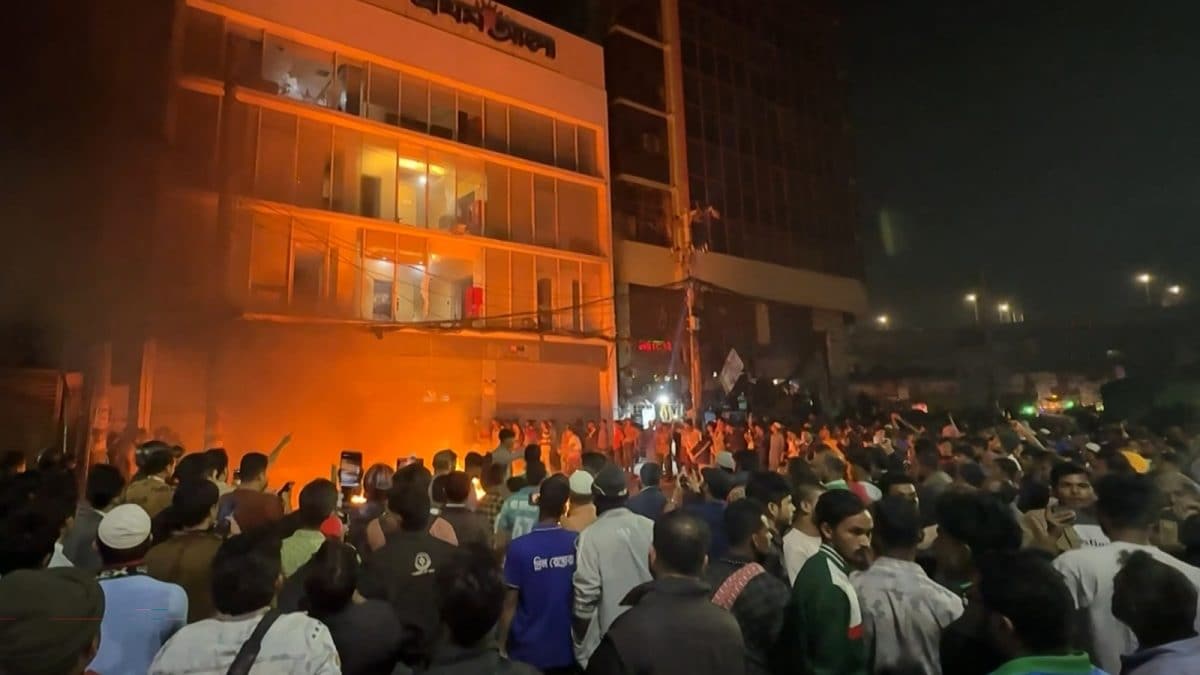
Prominent media houses in Bangladesh were vandalised amid violent protests. (AFP)
On December 18, 2025, the death of Sharif Osman Hadi, spokesperson of the Inqilab Mancha and a prospective candidate for the upcoming 13th National Parliamentary Election, triggered a rapid escalation of protests and violence across Bangladesh, exposing deepening political polarisation, institutional vulnerability, and rising anti-India sentiments.
Hadi, who had reportedly been shot in the head on December 12, 2025, by an armed man identified as Faisal Karim Masud aka Daud Khan, died at approximately 9:45 pm (BST) on December 18, 2025, while undergoing treatment in Singapore. His death acted as a catalyst for escalating nationwide unrest, rather than an isolated cause. Hadi was a fiery face in the July Uprising of 2024.
Masud fired the fatal shot while riding pillion on a motorcycle, and Alamgir Sheikh has been identified as the person who was driving the motorcycle at the time. The two fled after the attack and are said to have crossed into India via the Haluaghat border route the same night – a claim that authorities are still probing. A reward of BDT 5 million has been announced by the Government for Masud’s arrest.
Two persons, Sibion Diu and Sanjay Chisim, have been remanded by a Dhaka court for allegedly helping Masud escape after the shooting. Masud’s parents have also been sent to jail, after a ‘confessional statement’ before a magistrate.
Following the news of Hadi’s death, protesters began gathering in Dhaka’s Shahbagh area on the night of December 18. Demonstrators marched around the Shahbagh Police Station, chanting slogans such as “Tumi ke ami ke? Hadi, Hadi,” “Delhi na Dhaka? Dhaka, Dhaka,” “Surround the Indian embassy,” and “Inqilab Zindabad.” Shahbagh’s historical role as a mobilisation hub lent symbolic legitimacy to the protests and facilitated further crowd formation.
After 11:00 pm, violence escalated sharply as hundreds of protesters attacked and vandalised the offices of Prothom Alo and The Daily Star, two of the country’s leading media institutions. Protesters damaged glass panels, dragged furniture and documents outside, and set them on fire, while chanting religious and nationalist slogans including Nala-e-Takbir, Allahu Akbar and Bharoter Dalalera-Hushiar, Sabdhan (Agents of India, Beware). Law enforcement agencies were initially absent, resulting in several media employees being trapped on rooftops. The Army was eventually deployed at around 12:35 am on December 19 to restore control, highlighting a delayed security response during the critical escalation phase.
The unrest quickly spread beyond the capital city, Dhaka. In Rajshahi, protesters bulldozed the Rajshahi Metropolitan Awami League office, directly targeting the party’s infrastructure. Simultaneously, highways were blocked in several districts, disrupting transportation and indicating coordinated efforts to exert nationwide pressure.
On December 19, 2025, the violence further escalated into the personal targeting of political figures. In Bandarban, protesters set fire to the residence of former Chittagong Hill Tracts (CHT) Affairs Minister Bir Bahadur U Shwe Sing. Firefighters were initially prevented from extinguishing the blaze, necessitating intervention by the Army and Police to disperse the crowd. This incident marked a significant expansion in protest tactics, moving from institutional targets to the private property of former government officials.
Violence also assumed an international dimension as protesters attacked the Indian Assistant High Commission in Chittagong, reflecting intensifying anti-India sentiment following former Prime Minister Sheikh Hasina’s flight to New Delhi. After the Rajshahi incident, students from different halls of Rajshahi University also joined and protested by setting fire to the road, chanting anti-India slogans.
On December 14, 2025, Abdullah Al Jaber, member secretary of Inqilab Manch, had warned that if Hadi’s attackers fled to India and the Indian government sheltered or returned them, the Indian Embassy in Bangladesh would not be allowed to conduct any activities, inflaming anti-Indian sentiments with unsubstantiated claims.
Parallel to street violence, political reactions played a critical role in shaping the protest environment. On December 18, 2025, the Bangladesh Nationalist Party (BNP), Jamaat-e-Islami (JeI), National Citizen Party (NCP), and Islami Andolan of Bangladesh (IAB) issued statements expressing grief over Hadi’s death and demanding justice. BNP described Hadi a “martyr;” JeI referred to him as a “brave July fighter and true patriot;” NCP called him “our comrade”. These statements, while not directly calling for violence, contributed to legitimising public anger and intensifying mobilisation. The Government, meanwhile, has characterised the violence following Hadi’s death as criminal and condemned attacks on institutions, including media houses, while asserting security forces are working to restore order and uphold justice. The government statement also condemned the lynching of a Hindu man in Mymensingh.
Hadi was shot just after the elections in Bangladesh were formally announced, on December 11, 2025. The killing of such a political aspirant at this critical juncture of Bangladesh’s politics angered the public.
Collectively, the incidents following Hadi’s death expose a fragile security environment marked by delayed law enforcement responses, politicised narratives of martyrdom, and a narrative that fuels and normalises anti-Indian sentiments in the general public. These actions mark a shift from symbolic protest to physical disruption of political and economic activity. The events underscore the risk of protest-triggered violence becoming a recurring feature of Bangladesh’s political landscape.
Shivangi Sharma is a Research Assistant, Institute for Conflict Management. Views expressed are personal and solely those of the author. They do not necessarily reflect News18’s views.
December 21, 2025, 16:33 IST
Read More