



Last Updated:
‘Liberal’ euphemism cannot protect a society from jihadist violence. Only ideological clarity can


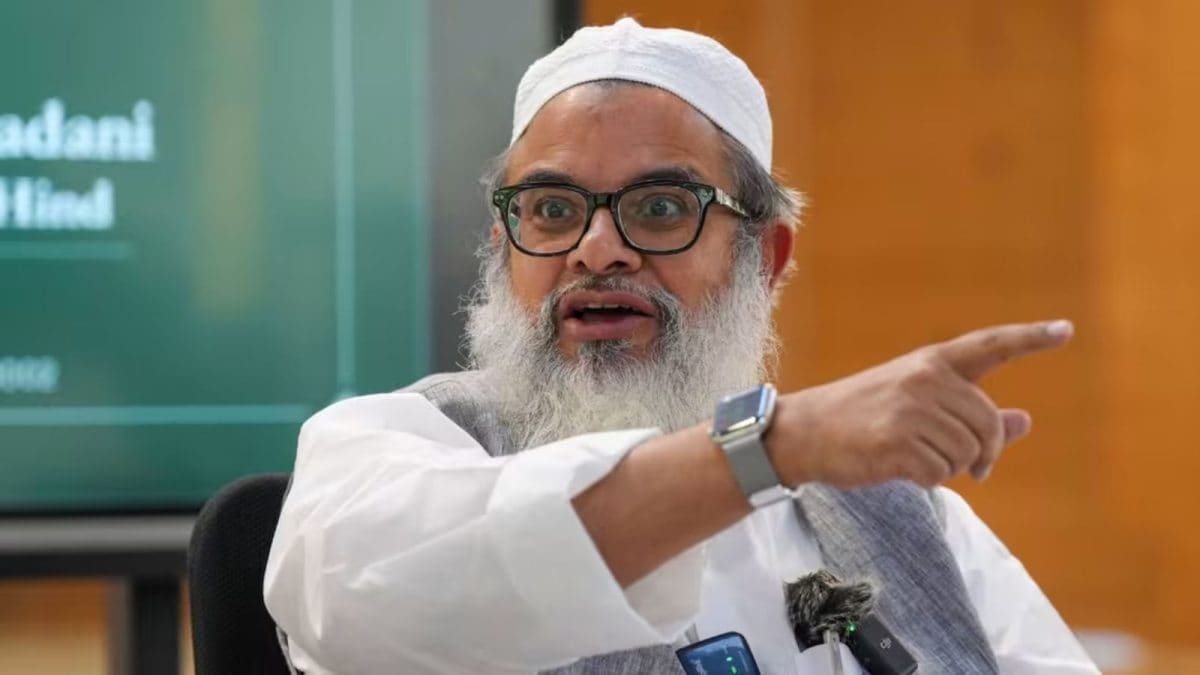
Jamiat Ulama-i-Hind president Maulana Mahmood Madani (File image)
Across the world — and increasingly in India — the term jihad has been so thoroughly sanitised that it barely resembles the concept found in Islam’s foundational texts or in centuries of historical practice.
Today, there has been a tendency to project jihad as a “pious struggle”, a synonym for personal resilience, a metaphor for charity, or even a tool to fight injustice, if not terrorism itself. This reinvention is not an honest evolution but the product of a sustained intellectual and political effort to reframe jihad in ways that make it more palatable to modern sensibilities and compatible with contemporary multicultural politics. So pervasive has been this tendency to humanise jihad that it threatens to blunt our ability to confront the very violence perpetrated explicitly in its name.
Consider two recent controversies. Jamiat Ulema-e-Hind chief Maulana Mahmood Madani declared that jihad has been unfairly given a “negative” meaning by the state and insisted it is merely a virtuous struggle against oppression. He went a step further, suggesting this version be taught in school textbooks. Soon after, a Samajwadi Party MP announced in the Lok Sabha that Indian Muslims may need to “do jihad” against governmental injustice. Both men rely on the same linguistic playbook: colouring an intensely religious act with secular, liberal sensibilities.
This tactic, though familiar, is outright dangerous. When leaders deploy a religious term whose canonical meaning is overwhelmingly militant but claim it is harmless, they create a moral and analytical fog. In that fog, jihad becomes a potent tool available to terrorists, fundamentalists, activists and moderates alike — each free to use it the way they want to forward their agenda. Such ambiguity does not civilise the discourse; it corrodes it.
No one described this phenomenon more bluntly than Ayaan Hirsi Ali. In her book Infidel, she recounts the growing propensity in the West to sugar-coat Islamist violence with sociological justifications — poverty, colonialism, humiliation, Islamophobia — while ignoring the explicit religio-ideological foundation behind the act. Such Western predispositions, she writes, produce “fairy tales” that have “nothing to do with the real world”, and insist on the “peaceful” nature of the “believers”.
In his foreword to Infidel, Christopher Hitchens amplifies this argument. He exposes the hollowness of the Western habit of celebrating those Muslim “moderates” who, when pressed on religio-doctrinal questions, take recourse to evasive action. To bolster his point, Hitchens gives the example of Tariq Ramadan, an Islamic scholar who was at the time of writing Infidel (2007) celebrated among ‘liberals’ for his ‘progressive’ views but in 2023 found “guilty of rape and sexual coercion” of a woman in a Geneva hotel 17 years ago by a Swiss court. Hitchens reminds his readers how Ramadan, when asked about Islam’s prescribed punishment for apostasy — death — did not condemn it; he merely called it “unimplementable”. Not wrong. Not immoral. Simply impractical at the present moment. The same “liberal” slipperiness emerged when Ramadan suggested a “moratorium” on stoning women for adultery. In other words, he merely wanted the heinous act to be paused for the time being. The West celebrates such Muslims and their skewed, opportunistic notions of liberalism.
Such intellectual thuggery produces two deceptions — both of which are well known in Bharat. The first is the tendency to find an alien enemy, which in Bharat’s case is Pakistan. There is no denying Pakistan is the epicentre of global terrorism and its entire existence depends on fighting Bharat, but no jihadist operation survives without local networks. Ideology does not need passports. Jihad, by its very nature, is borderless; it recognises and celebrates the ummah. Thus, the insistence that Pakistan alone is responsible for every strike is nothing but a political sedative.
The second deception is even more dangerous: it creates a sense of security and comfort when there exists none; it creates a sense of normalcy when there is anything but normalcy. A make-believe jihad is invented that is far more akin to a yoga-like inner peace programme, to charity drives, to moral advancement, and to a mechanism to fight oppression. It disowns the jihad that is invoked in the name of religion, dividing humanity into believers and non-believers, with no room for redemption for the latter. This normalisation of jihad conceals the fact that the much-advertised “greater jihad” of self-improvement appears rarely and occupies a marginal place in canonical literature.
To say this is not to malign ordinary Muslims. It is to point out a textual and historical reality: armed jihad was central to Islamic expansion — from the Arab conquests to the Ottoman frontiers, from North Africa to Persia, and, crucially, across the subcontinent. The linguistic consistency across these eras is striking: fight the unbelievers, wage jihad, and establish Dar-ul-Islam. And jihad is the preferred tool to achieve all this — and more.
That many Muslims today reject such divisive doctrines is commendable. But rejecting a doctrine is not the same as pretending it never existed. In the modern world, jihad has morphed into an all-front strategy: violent when conditions allow, non-violent when strategy requires. Islamist outfits openly espouse this. Yet, mainstream discourse tends to go the ostrich way — for the fear of being cancelled and labelled bigoted. So much so that, as Hitchens observes in Infidel, many liberals have become more offended by critiques of jihad than by jihadist violence itself.
This reluctance to see the truth comes with huge costs. First and foremost, it blinds societies to the ideological roots of extremist violence. If every act of Islamist terror is explained by poverty, unemployment and alienation, policymakers will forever address symptoms instead of causes. Second, it delegitimises genuine reformers and instead sees them as enemies and dismisses them as radicals and extremists, while clerics and Left-‘liberal’ opportunists are hailed as “moderates”. Third, and most dangerously, it leaves a sea of unsuspecting masses either unprepared or underprepared to deal with the fanatics.
A society that cannot name a problem cannot solve it. To confront extremist violence, one must first confront the vocabulary that legitimises it. This requires honesty about what jihad has meant, what it still means to those who invoke it, and why its sanitisation is not an act of compassion but an act of evasion. ‘Liberal’ euphemism cannot protect a society from jihadist violence. Only ideological clarity can.
Views expressed in the above piece are personal and solely those of the author. They do not necessarily reflect News18’s views.
 Click here to add News18 as your preferred news source on Google.
 December 05, 2025, 11:39 IST
Read More
