



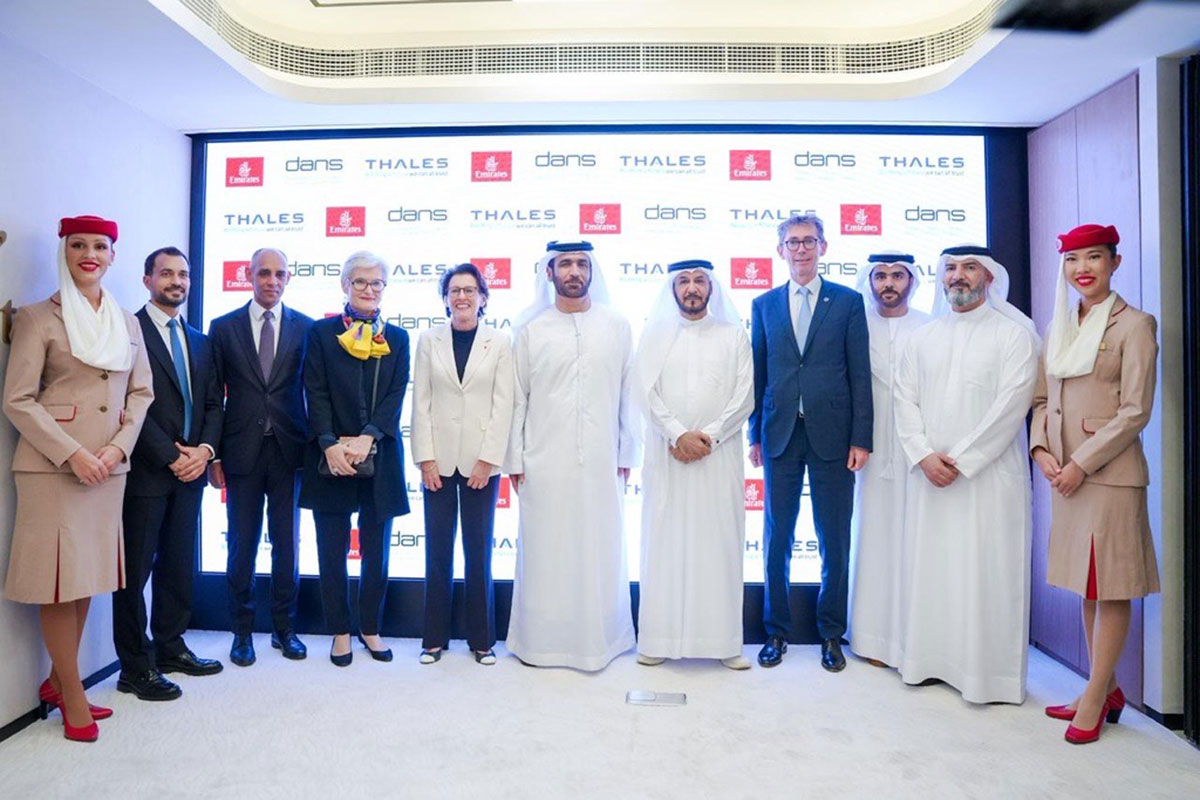
Dubai is working on a new system which will predict UAE airspace congestion and generate proactive recommendations that can lead to modified flight plans and reduce holding patterns by aircraft by up to 40 per cent.
To make this happen, Dubai Air Navigation Services (DANS), Emirates Airline and Thales have signed a Collaborative Research Agreement (CRA) to pioneer cutting-edge research aimed at reducing fuel burn and holding patterns for all flights arriving at Dubai International and support more efficient UAE airspace management.
Holding patterns provide a safe, orderly system to sequence arriving aircraft during peak traffic and runway congestion. Aircraft fly carefully choreographed racetrack-shaped circuits at designated altitudes to ensure smooth arrivals. While this is essential for safety and operational flow, minimising their occurrence reduces fuel consumption and associated carbon emissions.
The three partners will work together to research innovative ways to optimise aviation traffic management. Central to their efforts will be the integration of advanced AI technologies, which will play a pivotal role in identifying potential congestion areas and providing recommendations.
By leveraging these AI-driven insights, the collaboration aims to help air traffic controllers and airlines minimise delays, enhance predictability, and boost operational efficiency throughout the entire airspace network.
The French company Thales is known as a global leader in digital and ‘deep tech’ innovations – Big Data, artificial intelligence, connectivity, cybersecurity and quantum technology – with expertise in defence, aerospace and space, cyber and digital sectors.
Abdelhafid Mordi, Vice President of Thales in UAE and Iraq, and CEO of Thales Emarat Technologies, commented: “This innovative partnership with Dubai Air Navigation Services and Emirates Airline will allow us to strengthen the UAE’s airspace management technologies.
“Thales will bring its advanced capabilities in digital technologies, AI, and air traffic management, to support the UAE’s vision of a more secure, connected, and sustainable aviation sector.”
Adel Al Redha, Deputy President and Chief Operating Officer Emirates Airline, said: “This research agreement with Thales and DANS represents a practical application of AI to solve a real operational challenge. By predicting congestion and adjusting cruise speeds proactively, we not only reduce fuel burn associated with holding patterns, but also optimise our operational efficiencies.
“If successful, this solution can benefit other airlines, turning a shared problem into an opportunity for improvement.”
Ibrahim Ahli, Chief Executive Officer of Dubai Air Navigation Services, said: “At DANS, enhancing the efficiency and sustainability of UAE airspace operations is a priority we work toward every day.
“Our collaboration with Emirates Airline and Thales allows us to leverage advanced AI technologies to reduce holding patterns, enhance predictability, and enable smoother, safer arrivals into Dubai. We aim to deliver measurable improvements for air traffic controllers, airlines, and the wider aviation ecosystem by integrating real-time operational data with intelligent forecasting.”
