



Confirmation coming Friday after Canada’s inflation-adjusted GDP declined 0.4% in second quarter of year
Article content
While Canada is expected to avoid a technical recession this year — we’ll know for sure on Friday when Statistics Canada releases the relevant economic data — there will be little cause for celebrating.
Advertisement 2

Article content
Canada’s inflation-adjusted gross domestic product declined 0.4% in the second quarter of this year, which included April, May and June.
Article content
Article content
A second decline in the third quarter (July, August and September) would mean Canada is in a technical recession of two successive quarters of negative economic growth. But most economists, and the early indications from Statistics Canada, suggest the economy expanded slightly in the third quarter, thus avoiding a technical recession.
It’s true that U.S. President Donald Trump’s tariff war, which has been going on since he was sworn in on Jan. 20, hasn’t helped our economy. But the bad news is that our economy was already weak and long before Trump was elected.
Trudeau-era economic damage lingering
That’s because of low productivity caused by a lack of business investment and innovation in Canada due to high taxation and cumbersome regulatory policies.

Your Midday Sun
Article content
Advertisement 3
Article content
During the lost decade under Justin Trudeau’s Liberal government, Canada recorded the second-worst record of economic growth as defined by real GDP per capita among the 38 developed nations that belong to the Organization for Economic Co-operation and Development. Only Luxembourg did worse.
Trudeau’s record on economic growth was also the worst of any Canadian government since the government of R.B. Bennett during the Great Depression.
In addition, while inflation has abated recently, the cumulative impact of years of high inflation in the wake of the 2020 pandemic means the cost of basic necessities, such as food and housing, have reached crisis levels for many Canadian families.
RECOMMENDED VIDEO

We apologize, but this video has failed to load.
Canadian families struggling to make ends meet
To Canadians struggling to put food on the table and pay the rent, whether Canada narrowly dodges a technical recession this year and next means little.
Advertisement 4
Article content
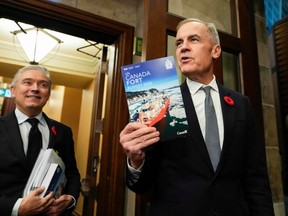
The solutions proposed by Prime Minister Mark Carney — seeking out new foreign markets beyond the U.S., increasing the supply of affordable housing and fast-tracking the creation of more private and public infrastructure, including so-called “national-building” projects — will take time to implement.
That’s assuming they are carried out competently, always a concern with this federal government based on years of scathing reports from the parliamentary budget officer and the auditor general.
Read More

Article content
