








Two recent episodes involving China-U.S. relations underline an unexpected convergence in the relationship and the potential for these episodes to have a wider impact on the transitioning global order.
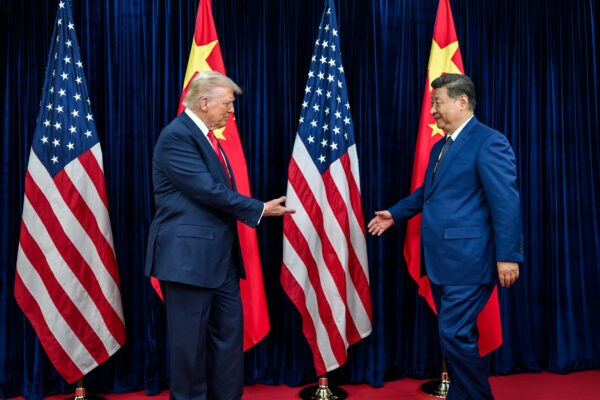
First, Presidents Donald Trump and Xi Jinping met on the sidelines of the APEC meeting held in Busan on October 30, 2025, their first meeting since 2019. The agreements reached were not unexpected, largely unambitious, and mostly involved reversals and reinstatements of past policies, welded together by the expectation that there would be follow-on summit meetings between Trump and Xi in the spring and fall of 2026.
Secondly, the U.S. National Security Strategy (NSS) document was officially published in November 2025. It predominantly casts China as an economic competitor and accords it an implicit status as one of the “larger, richer, stronger” countries that is, and should be, shaping global order.
There is little or nothing in these agreements or the strategy document that suggests China is viewed as a serious revisionist threat either to global order or U.S. interests. Rather, it appears as a state that has earned its own sphere of influence, which the United States may or may not choose to accept. Moreover, the idea of a revisionist China recedes further when thought about in the presence of a Trump administration that is upending the main tenets of the post-1945 order.
For those who have been exploring the question of whether China might actually be promoting an alternative global order, of necessity, now face a much harder task in coming to any conclusion.
Comparing the First and Second Trump Administrations
These perspectives on U.S. convergence with China are brought into sharper focus when examined through the comparative lens of the first and second Trump administrations. As is well known, Trump came into office in 2017, fixated on the trade in goods deficit with China, and began using tariffs as his weapon of choice to achieve greater balance in trade ties. He also appeared to view China as a supplicant. The assumption then was that China was more dependent on the U.S. market than the United States was on China – a form of asymmetrical interdependence that the U.S. government would be able to leverage.
Elsewhere in that first Trump administration, however, others had far larger concerns about China (notably, Vice President Mike Pence and Secretary of State Mike Pompeo). At this stage, they were in a position to influence the direction of policy because Trump was not wholly in charge of the China brief and was induced to stand by as the National Security Council coordinated policy from a “whole of society” threat perspective.
Meanwhile, Xi had come to power in late 2012-2013 determined to pursue an industrial strategy that would enhance China’s capacity to produce critical advanced technologies and achieve global leadership in high-end manufacturing. Beijing invested heavily in dual-use technologies that are seen to be at the leading edge of future commercial and military innovation, including AI, robotics, telecommunications, and quantum computing. The aim was to ensure that by 2030, China would become a major leader in these fields, and in consequence, any idea of asymmetry in the China-U.S. relationship would be seen to have diminished.
Second Term Shifts
Trump’s second term has demonstrated three major shifts in the approach to China. Of greatest significance is that Trump has put himself firmly in charge of China policy, and of much else as the NSS suggests, given its personalistic framing of America’s “strategy.” The China hawks are reined in.
Secondly, Trump is also willing to accord China a high status, with the G2 approach to negotiation making a reappearance. In addition, Trump has continued to use superlatives with regard to China’s president, in particular referencing Xi Jinping’s brilliance, and offering him both his respect and standing as a “very good friend.”
Thirdly, Trump’s actions and statements suggest a convergence based on Trump’s generalized economic punishment of most states in the global system; the reprioritization of the main security threat to the United States; and the embrace of illiberal principles.
The “America First” policy has meant that every relationship with the United States — friend or foe, ally or adversary — is under the microscope. The April “Liberation Day” tariffs were directed at more than 100 countries. Thus, whether you are India, Italy, the Republic of Korea, Vietnam, or China you are examined through a similar lens. Your strategic positioning matters less than your economic relationship with the United States.
New partnership arrangements with countries that were supposed to help balance Chinese power, such as India and Vietnam, can also be targeted and damaged. Taiwan, which has similarly been subjected to the imposition of tariffs, suffered the downgrading of a defense dialogue with the United States, its president was denied a stopover visit in New York, and U.S. arms sales to Taiwan have appeared to relate as much to the economic benefits that would accrue to the United States as to any increase in Taiwan’s deterrence capabilities.
Turning again to the 2025 NSS, the document places U.S. regional and domestic security threats over the struggle against adversaries such as Russia and China. The focus is heavily on the security threat from within, in response to which Trump has deployed the National Guard and Federal troops to support so-called law enforcement inside U.S. cities. If the strategy reaches beyond the United States, then the emphasis is again on establishing an American sphere of influence — sometimes termed a Trump-inflected Monroe Doctrine– that will protect and strengthen the United States itself. Military attacks on ships allegedly carrying suspected drug dealers (especially those emanating from Venezuela), the establishment of a militarized zone across the Mexican border, and the renaming of the Gulf of Mexico as the Gulf of America all reinforce this perception.
In ideational terms, Trump has firmly rejected liberal universalism and shown a clear preference for autocratic regimes and rightist political parties and politicians in Latin America, Europe and beyond. The president is not interested in advancing a global or domestic human rights policy (unless it can be used as some form of leverage). He has removed the United States from the U.N. Human Rights Council, and reshaped and downgraded the annual U.S. State Department Report on the condition of human rights in countries around the world. Trump is also plainly not constrained by international humanitarian law and has attacked those bodies, such as the International Criminal Court, that search for some form of accountability for international criminal action. He, like Xi’s China, is not supportive of an activist civil society unless non-governmental forces can align their stances with the dominant policy line.
Thus, while there is much underlying this relationship that structurally causes serious tension and the two states have become peer competitors in several issue areas, China and the United States’ world views have come into closer alignment in our current era. Both governments are strongly sovereigntist, anti-liberal, and proponents of anti-liberal norms that have world order consequences.
Divergence Amid Convergence
However, the two polities go about the enactment of their policies in significantly different ways. What we see, broadly, is a U.S. separation from global society versus deepened Chinese connectivity.
On the U.S. side, Washington has not only been destabilizing ties with allies and partners but has also made funding cuts to domestic and international institutions that have underpinned its dominant role in the world, including withdrawal from a number of key multilateral international organizations. The United States seems intent on repelling or separating from other states — for example, withdrawing from the Paris Agreement on climate change, the U.N. Human Rights Council, and the U.N.’s Sustainable Development Goals agenda. Washington has also made major cuts to its U.N. funding, including failing to pay (so far) its assessed dues to the U.N.’s regular and peacekeeping budgets for 2025. Unless this is shortly reversed, China will emerge as the largest contributor to these U.N.-assessed budgets.
China’s approach is entirely different: not only has Beijing begun to contribute to global public goods but it has chosen to do this via the creation and shaping of multilateral international organizations in addition to doubling down on its bilateral relationships. The Belt and Road Initiative (BRI), the Asian Infrastructure Investment Bank (AIIB), the Forum on China-Africa Cooperation, participation in a BRICS+ arrangement, together with membership of an expanded Shanghai Cooperation Organization (SCO), are just a few examples that show how China is investing resources that develop connectivity politics around the world.
It is not difficult, therefore, to imagine that in comparative terms, Beijing will be perceived as a more predictable, stable, deliberative diplomatic actor than the United States. Already, many of its policy positions generate support, particularly as they focus on specific sets of policies that many other countries in the world appear to prioritize – economic development, the adoption of green technologies, climate change, and poverty reduction. And all this is undertaken without the conditionalities often seen as intrusive and associated with Western or U.S. largesse. Support for non-interference by external actors in a country’s domestic affairs has become closely identified with a more globalist China.
Even if there are many examples where China fails to implement the “public goods” policies it champions, and even where the form that these policies take comes to be resented or fail to reach the outcomes promised, the United States has seriously diminished as an actor in policy areas such as these. Thus, we are witnessing a form of convergence that has given China the promise of a distinctive lead in terms of its soft and hard power.
World Order Consequences
Despite the different foreign policy approaches adopted by China and the United States, where they do come together is in the perceived importance of the personalised state in both polities. Both Trump and Xi cast themselves as the primary architects of their foreign and domestic policies. That architecture contains similar content: they are both less protective of the security of the individual in favor of strengthening an ethno-nationalist state; and they are similarly dismissive of the benefits of an autonomous civil society. Both deny the centrality to global order of universal, agreed-upon, international human rights laws and norms.
In addition, both Beijing and Washington are selective in the issues to which they pay attention and offer resources. Even though China’s various policy initiatives, multilateral engagements, and economic reach suggest a more globalist perspective when compared with the current U.S. administration, Beijing, too, is likely to be selective and will not look to fill gaps that the Trump administration has opened.
Beijing and Washington’s respective perspectives add up to a world of diminished normative ambition. A personalized form of state-centrism, including support for the idea of nationally determined contributions, to the neglect of issues that require a collective response, suggests a world order that is based on a series of ad hoc agreements – a minimalist form of order at a time of disruption, if not peril.