




InterGlobe Aviation Ltd, which runs IndiGo, has detailed its hiring ramp-up in a submission to the Directorate General of Civil Aviation (DGCA), according to a document reviewed by Mint. The airline will hire 300 captains and 600 junior first officers over the next 12 months, the document said.
“Indigo have an under training pool of 250 junior first officers over the next 12 months, IndiGo shall hire/upgrade 300 captains and 600 junior first officers to cater for our medium term requirements,” the airline wrote in its submission to DGCA.
For IndiGo’s Airbus fleet, captain availability in December is 2,357 and first-officer strength is 2,194, the document showed. IndiGo plans to add 25 captains and 35 first officers by the end of December, another 28 captains and 35 first officers in January, and 15 captains and 20 first officers by 10 February. In total, this would add 68 captains and 90 first officers by that date, taking the combined tally to 2,425 captains and 2,284 first officers.
An email has been sent to IndiGo, and Mint will update the story once the airline responds. As per the airline’s FY25 annual report, it had 5,456 pilots including first officers and captains.
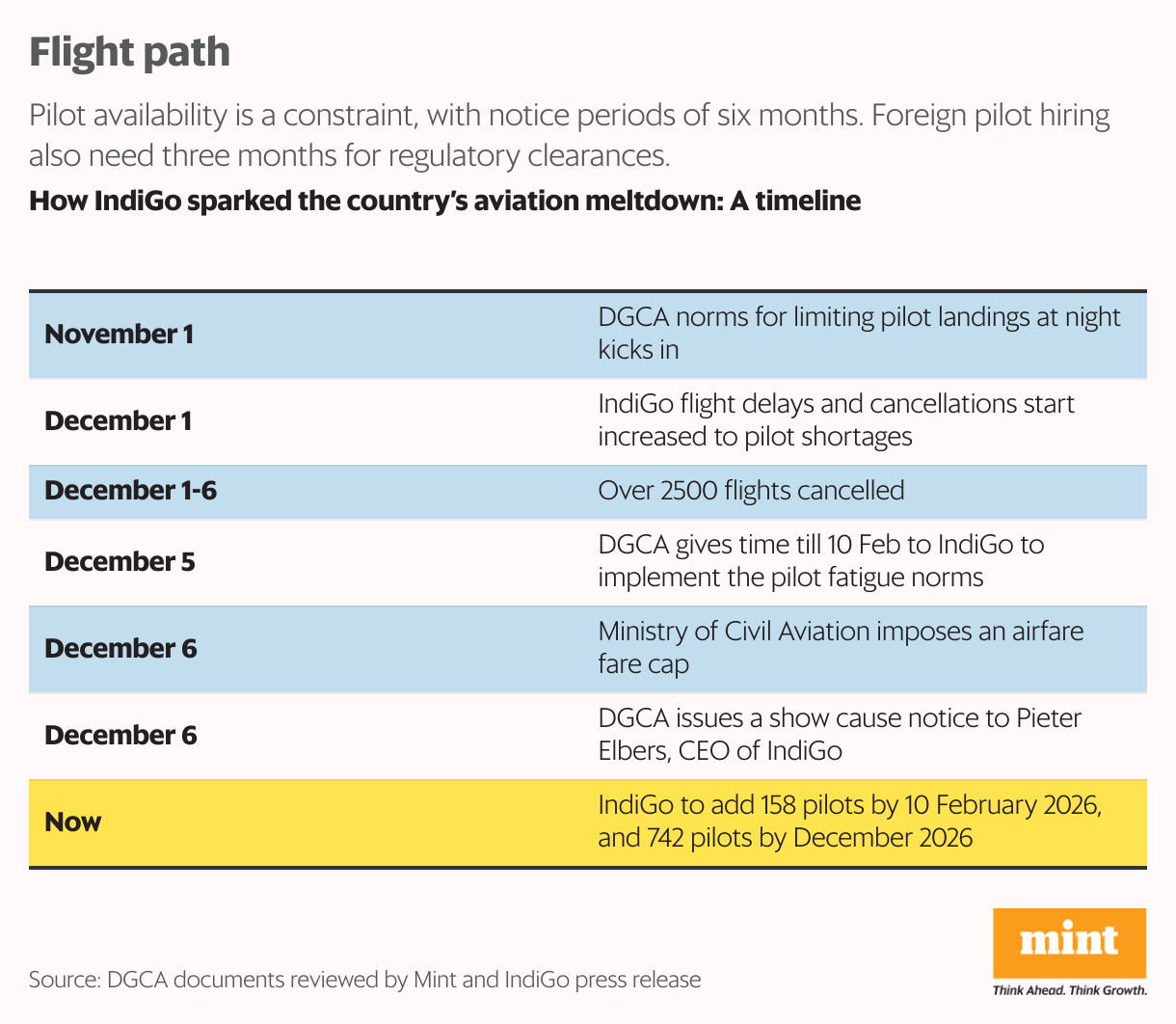
The 10 February deadline is critical because the aviation regulator has given IndiGo time until then to fully comply with new limits on consecutive night operations. DGCA had proposed two rules for all airlines. The first, which took effect on 1 July and expanded weekly rest to up to 48 hours while prohibiting airlines from substituting various forms of leave with weekly rest, has since been rolled back.
The second rule, effective 1 November, limits pilots to two back-to-back flights between midnight and 6 am. This applies to all airlines except IndiGo, which has been granted additional time. The rule increases crew requirements because each pilot can operate night flights for only two consecutive nights before mandatory rest.
In its submission to DGCA, IndiGo said it would cancel 300-400 flights a day during 5-8 December to reset its schedule and stabilise operations. A revised roster for 10-31 December would follow, the airline said.
Hiring challenges
Even so, analysts noted that scaling up hiring quickly will be difficult. The airline started looking at fresh hirings after an operational meltdown in which it cancelled over 3,600 flights over 35 days starting 1 November.
Elara Securities estimated that IndiGo may need to hire at least 1,000 pilots to comply with FDTL norms by February, based on comparisons of pilot strength and fleet size.
“However, meeting this target could be challenging, as poaching talent is difficult due to long notice periods – six months for co-pilots and 12 months for captain,” said Gagan Dixit, senior vice president oil & gas and aviation, Elara Securities.
Another aviation expert expressed similar concerns. IndiGo needs to get these people on board by 10 February, and this is “not an easy task,” said Mark D Martin, chief executive, Martin Consulting, an aviation safety expert.
Immediate availability remains a constraint, with notice periods of at least six months, he noted. Hiring foreign pilots also requires a minimum of three months to meet regulatory clearances, he said.
Structural shortages
As per its last investor presentation, IndiGo has a fleet of 417 aircraft, comprising A320s, ATRs, a Boeing jet on wet lease from Turkish Airlines, and freighters. Nearly 40 A320s remain grounded because of engine issues with supplier Pratt & Whitney. Its effective flying fleet of A320s—the single-aisle narrow-body jets—stands at around 325.
These aircraft are being “sweated” at about 14 hours a day, compared to the standard 8.5 hours. That elevates crew requirements: instead of 14 pilot-and-copilot sets, IndiGo needs at least 17 for its utilization levels.
Calculations by Martin Consulting show that with 17 sets and 325 flying A320s, IndiGo’s crew requirement is 5,525. Its last DGCA submission showed a crew count of 4,551 for December, a shortfall of 974 pilots.
“Typically, to run an Airbus 320 (for 8-9 hours of flying) you need seven pilots and seven copilots. Now if the airline is flying more than these 8-9 hours, your pilot requirement will go up,” CS Randawa, president, Federation of Indian Pilots, told Mint.
A Mint analysis of the winter schedule and pilot numbers disclosed by Minister of State for Civil Aviation Murlidhar Mohol found IndiGo has 2.5 pilots per departure. That is substantially lower than competitors such as Air India at 5.4, Air India Express at 4.7, and Akasa at 5.4. Competitors also operate different fleet mixes—Boeing and Airbus for Air India Group, Boeing-only for Akasa—which shifts crew-set requirements.
“An IndiGo pilot is flying at least 20% more than the industry average. So even if IndiGo goes on a hiring spree, it won’t be easy to get that many pilots on board,” said Martin.
A note by InCred Equities said that in FY24, IndiGo pilots flew more aircraft hours (571 per pilot) than Tata (471) or the industry average excluding IndiGo (453), indicating tighter scheduling.
Pilot salaries account for 60% of IndiGo’s employee costs; a 20% raise could increase total employee costs by 12%, the InCred note said.
