



The year 2025 has ushered in a paradigm shift in personal technology, showcasing a remarkable blend of advanced Artificial Intelligence, revolutionary form factors, and immersive extended reality experiences. This year’s most innovative products aren’t just incremental updates – they represent bold leaps forward, fundamentally changing how we interact with our digital and physical worlds.
From Samsung’s Galaxy XR headset taking the charge for augmented reality devices to Meta’s Ray-Ban Display glasses starring AR features, here’s a deep dive into the groundbreaking tech products that defined innovation in 2025.
Samsung Galaxy Z Tri-Fold
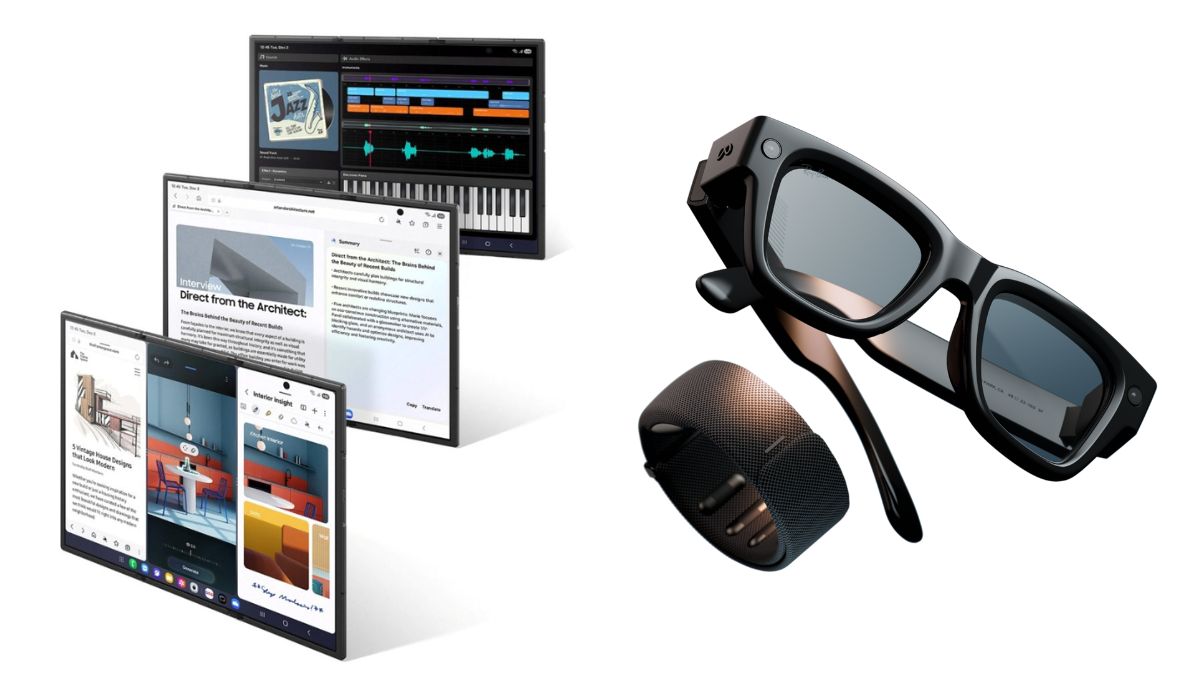
Breaking free from the conventional foldable design, the Samsung Galaxy Z Tri-Fold stands out as a monumental achievement in mobile engineering. Unlike its predecessors, this device features two inward-folding hinges, allowing it to transform from a standard smartphone form factor into an expansive tablet-sized display.
When fully unfolded, users are greeted with a seamless, large screen that redefines mobile productivity and entertainment. This innovation in smartphones has set a new benchmark, appealing to power users who demand maximum screen real estate without compromising pocketability, thus merging the best of phone and tablet into one dynamic device.
Apple iPhone Air
The iPhone Air made waves with its incredibly thin and lightweight design, without sacrificing performance. Building on the success of the MacBook Air, this iPhone variant pushed the boundaries of miniaturisation and material science. It features a new generation of Apple Silicon, optimised for efficiency, delivering top-tier performance for its featherweight chassis.
The iPhone Air appeals to users who prioritise sleek aesthetics, minimal bulk, and long-lasting battery life in a premium smartphone experience, solidifying its place as a design icon in the mobile market, even though sales figures may not do it justice.
Agentic AI
While not a singular product, the release of Agentic AI in 2025 is arguably the most impactful technological innovation. Moving beyond reactive chatbots and basic task automation, Agentic AI refers to autonomous software systems capable of understanding complex goals, planning multi-step actions, making independent decisions, and executing tasks without constant human oversight.
These AI agents can orchestrate workflows, manage projects, perform research, and even self-correct, fundamentally transforming industries from software development to scientific discovery and customer service. Their integration into consumer products and enterprise solutions promises a future where AI acts as a true proactive partner rather than just a tool.
Meta Ray-Ban Display
Meta and Ray-Ban continued their collaboration with the Meta Ray-Ban Display, a significant leap in smart glasses technology. This iteration integrates a discreet, high-resolution micro-LED display directly into the lens, offering augmented reality (AR) overlays without obstructing natural vision.
Users can now seamlessly view notifications, navigation directions, real-time translations, and even interact with Meta AI directly through glanceable visuals, all while maintaining the classic Ray-Ban aesthetic. This product is positioned to finally make AR glasses a mainstream, stylish, and genuinely useful daily wearable.
Samsung Galaxy XR
Samsung made a bold entry into the high-end extended reality (XR) space with the Samsung Galaxy XR headset, competing with the Apple Vision Pro. This device is a comprehensive mixed reality platform, offering both virtual reality (VR) and sophisticated pass-through augmented reality.
Powered by a dedicated Snapdragon processor, the Galaxy XR delivers great visual fidelity and precise hand tracking, catering to both immersive gaming and professional applications. Its open ecosystem approach, leveraging the Android XR platform, aims to develop a rich app environment, positioning it as a direct competitor in the burgeoning premium XR market.
