



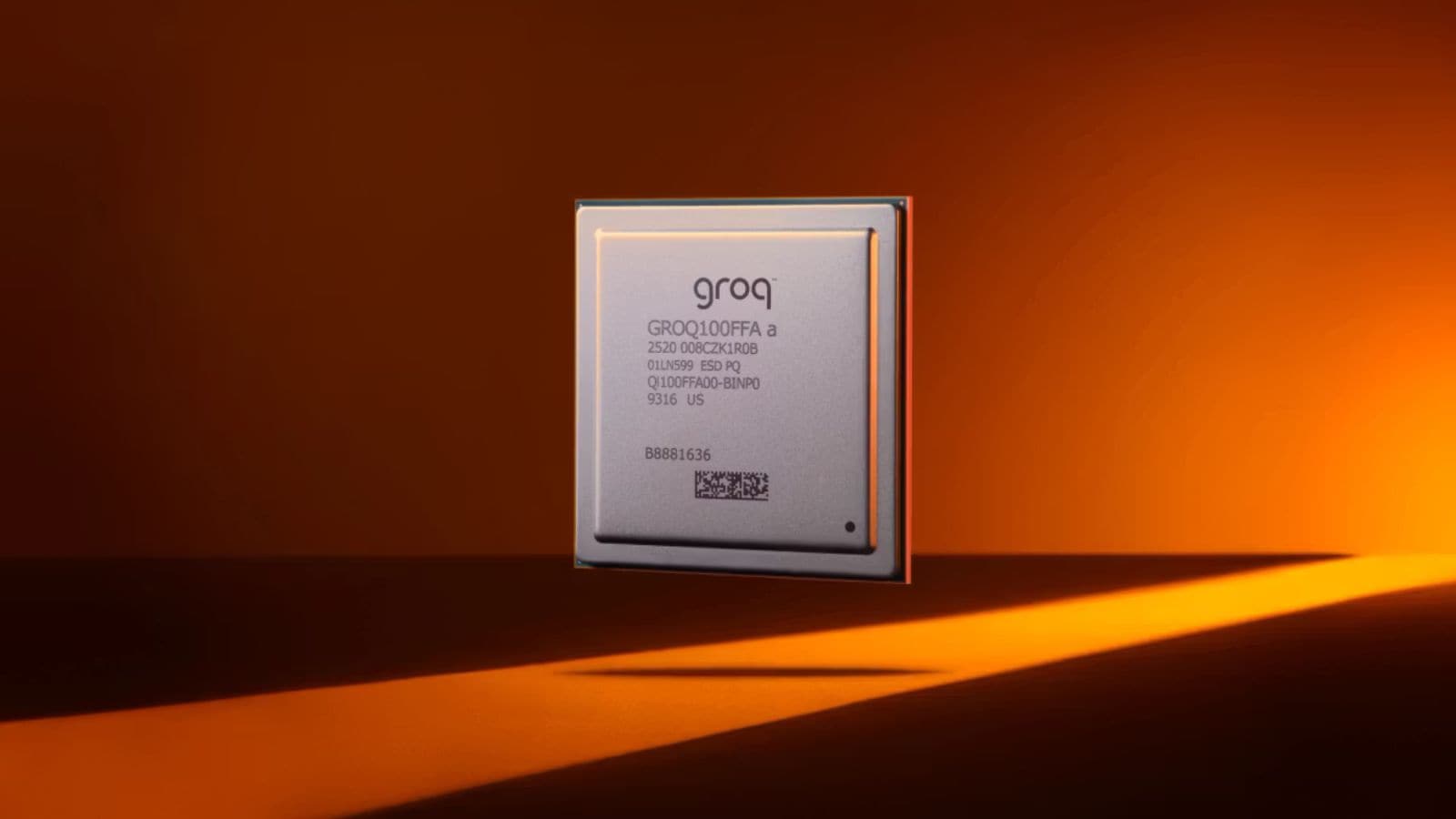
Nvidia has agreed to pay $20 billion to AI chip startup Groq to licence its AI inference hardware, while recruiting several of its employees, including its founder, in an unexpected deal that underscores how the fight for AI chip dominance is only growing more intense.
Groq on Wednesday, December 24, said that it has entered into a non-exclusive licensing agreement with Nvidia in order to provide expanded access to its high-performance, low-cost inference chips. To help advance and scale the licenced technology, Groq CEO Jonathan Ross, president Sunny Madra, and other members of the AI chip startup will be joining Nvidia. Groq’s new CEO will be Simon Edwards, and it will continue to operate as an independent company even after the Nvidia partnership.

While the full financial details have not been disclosed, the $20 billion-dollar licensing deal is reportedly Nvidia’s largest purchase of any technology so far. It is also about three times of Groq’s $6.9 billion valuation after closing a $750 million-dollar financing round just a few months ago. The non-exclusive licensing agreement is significant in light of two important developments shaping the AI industry:
First, the Groq deal comes amid a growing narrative that Nvidia’s unquestioned control over the AI chip market is fracturing. It suggests that the industry leader sees strategic value in licensing and absorbing inference technology from its emerging rivals, even as focus shifts from training-centric GPUs that characterised the early period of AI development to custom silicon.
Second, the deal reinforces the trend of acqui-hires within the AI industry, where having in-house talent and specialised expertise is becoming just as critical as access to the hardware or technology itself.
Nvidia: Growing competition, strategic bets
Investors have been jittery about potential competition for Nvidia since its AI chip business exploded in the middle of 2023, a few months after OpenAI released its world-changing ChatGPT. Since then Nvidia’s quarterly revenue has expanded to $57 billion from $7 billion. Major hyperscalers such as Google, Microsoft, Amazon, Meta, and Oracle have come to rely heavily on Nvidia’s graphics processing units (GPUs) to train and develop their own AI models as well as rent them out to AI startups like OpenAI and Anthropic.
But Nvidia’s blockbuster success has also invited an array of potential rivals, ranging from established players such as Advanced Micro Devices (AMD) and Broadcom to well-funded upstarts like Groq and Cerebras. Tech giants such as Google, Amazon, and Apple have also been developing in-house, custom-built AI chips to break their costly dependence on Nvidia’s GPUs.
Story continues below this ad
So far, the sheer quality of Nvidia’s chips has maintained its edge. Yet, Google is mounting a serious challenge since the release of Gemini 3, its latest family of AI models that was hailed as a major improvement and is reportedly developed entirely on the company’s tensor processing units (TPUs) — a type of custom application-specific integrated circuits (ASICs) whose performance relative to GPUs is still under question, yet is emerging as a potential alternative.
Faced with growing competition, Nvidia has strategically ramped up its investments in chip startups and the broader ecosystem. Till October 2025, Nvidia had $60.6 billion in cash and short-term investments, up from $13.3 billion in early 2023, according to a report by The Information.
It bought Israeli chip designer Mellanox for close to $7 billion in 2019. As part of a similar but smaller deal than the Groq agreement, Nvidia said in September 2025, that it would shell out $900 million to licence AI hardware startup Enfabrica’s technology while hiring its CEO and other employees.
Nvidia has also backed AI and energy infrastructure company Crusoe, AI model developer Cohere, and AI-centric cloud provider CoreWeave. It has further invested $5 billion in Intel as part of a partnership, and struck a $100 billion investment deal with OpenAI in exchange for a commitment from the ChatGPT maker to deploy at least 10 gigawatts of its chips.
Story continues below this ad
Groq: TPU roots, inference play
GPUs are said to work well for training AI models, but as the technology matures and competition increases, companies are looking to optimise AI model inferencing, where the model is made to generate outputs on previously unseen data. During the past few months, the AI industry has shifted focus to hardware designed specifically for inferencing in order to improve the overall quality of AI models.
This is where Groq comes in. Founded in 2016, the US semiconductor startup is known for producing AI inference chips that it calls LPUs (language processing units), and which can be used to optimise pre-trained models. “Inference is defining this era of AI, and we’re building the American infrastructure that delivers it with high speed and low cost,” Jonathan Ross, Groq founder and CEO, has previously said.
Notably, Ross is a former Google engineer and one of the creators of the tech giant’s custom TPU chips. Groq’s investors include Samsung, Cisco, Blackrock, Neuberger Berman, Altimeter Capital, Social Capital, and 1789 Capital, which reportedly counts US President Donald Trump’s son, Donald Trump Jr, as one of its partners.
Groq’s products are primarily aimed at developers and enterprises. They are made accessible as either a cloud service or an on-premises hardware cluster. Together, they are used to power AI applications built by more than two million developers, according to a recent TechCrunch report. Its cloud service and on-prem hardware are also used to run popular open-weight AI models developed by Meta, DeepSeek, Qwen, Mistral, Google, and OpenAI. The company has said that its offerings maintain and sometimes even improve the performance of AI models at a significantly lesser cost than alternatives.
Story continues below this ad
Nvidia CEO Jensen Huang has said that the trillion-dollar company’s agreement with Groq will expand its capabilities. “We plan to integrate Groq’s low-latency processors into the NVIDIA AI factory architecture, extending the platform to serve an even broader range of AI inference and real-time workloads,” Huang was quoted as saying by CNBC.
